Can Do Pull-Ups but Not a Muscle-Up? What to Check
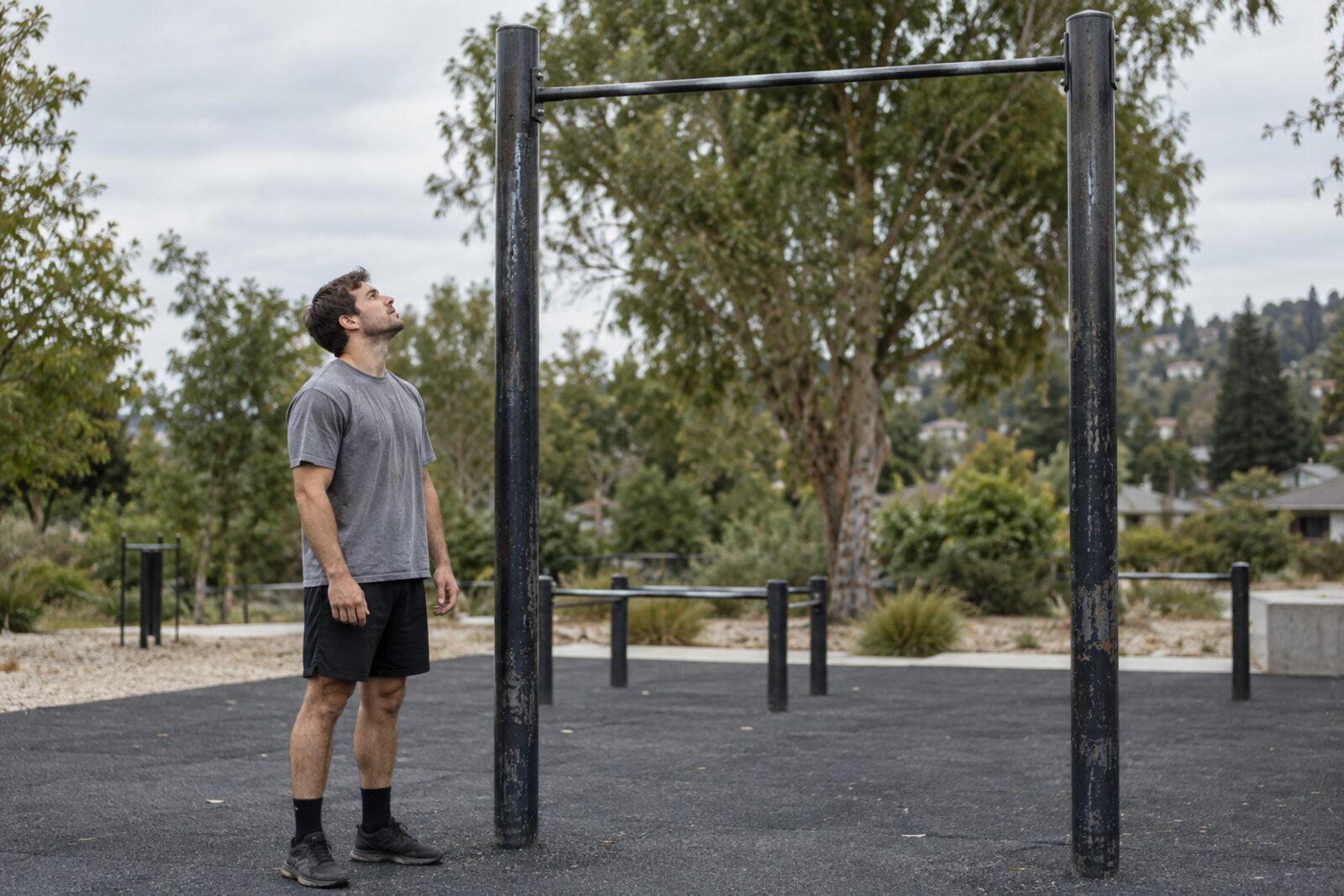
Fifteen pull-ups show that you can get your chin over the bar many times in a row. They say much less about the rest of a muscle-up, which requires you to pull higher, move your body above the bar and press out. Before you chase twenty pull-ups, find the point where your muscle-up attempt, or a supported version of it, stops.
The answer also depends on which muscle-up you want. A strict bar muscle-up, a kipping bar muscle-up and a strict ring muscle-up each need different practice, and no pull-up count on its own settles whether you are ready for a full attempt at any of them. The practice in this article is for a strict bar muscle-up. The ring and kipping comparisons are there to help you recognize when your goal needs a different progression.
Which muscle-up you are training for
| Target | What distinguishes it | What a regular pull-up count leaves out |
|---|---|---|
| Strict bar muscle-up | You travel around a fixed bar without a deliberate kip | Pulling high enough, getting above the bar and completing the straight-bar press |
| Kipping bar muscle-up | A coordinated swing helps you get above the bar | Swing control, timing, the transition and a stable support at the finish |
| Strict ring muscle-up | The rings move around your torso during the transition, with no deliberate kip | Ring control, grip through the transition and pressing from the receiving position |
A strict pull can still be fast and forceful. Strict describes the absence of a kip, so it has nothing to do with moving slowly. Ring muscle-ups can be kipped as well, but the ring material in this article concerns the strict version.
On a fixed bar, the transition takes you from hanging below the bar to supporting yourself above it. Your torso has to rise far enough for that route to exist, and a chin that clears the bar is only part of the way there. CrossFit's explanation of the strict bar muscle-up makes the same distinction.
Rings move to the side of your torso during the transition, whereas a fixed bar stays where it is and your body has to travel around it. A false grip helps keep the hands in position through a ring transition, although it removes none of the pulling, transition and support strength the movement demands. For that reason, a ring drill or a ring readiness number does not transfer directly to a strict bar goal.
Forma's current muscle-up tree includes false-grip pull-ups, eccentric muscle-ups, kipping muscle-ups and muscle-ups. Its coaching separates a kipping rep from a rep without a kip, but some instructions cover bars and rings together, so keep your chosen apparatus and version explicit in your notes. The supported strict-bar practice in this article does not reproduce that tree step by step, and you can learn a strict muscle-up without ever learning to kip.
Watch the movement before you add another drill
If your current practice is controlled and pain-free, a side-view recording lets you or a coach see where the movement changes. When an unassisted attempt is not yet controlled, record a supported version instead, and keep the whole apparatus and your body in the frame.
Describe what you see before you guess at the cause. "My chin clears, but my chest stays below the bar" is a useful observation. "My lats are weak" goes beyond anything the video can show. If the height or the route is unclear, mark it as uncertain and take that question to a coach.
| What you observe | Practice to consider |
|---|---|
| Your chin clears, but your torso stays below the position needed to turn over | Use the assisted high pulls described later, and record how high you reach at the same assistance, without a turnover |
| You get close to turning over, then fall away | Have a coach check the height and route if either is unclear, and practice the route with a foot-assisted low-bar transition |
| You arrive above the bar but cannot press out | On a secure low bar, keep your feet supported while you practice that position and the press, with enough leg help to avoid sinking into a position you cannot control |
| On rings, your hands slide during the transition | Keep your feet supported and use enough leg assistance to stay in control. Check the grip and ring position before you reduce that help, and get setup guidance if the hand position is new to you. |
| You can complete a foot-assisted transition but miss the full movement | Keep the supported version and reduce the help gradually while the route stays the same. A miss alone does not tell you whether strength or timing is responsible. |
| A kipping attempt turns into a larger, uncontrolled swing | Go back to coach-led basic swing practice on a suitable rig |
For trouble with ordinary pull-ups, the plateau checklist and the progression guide are the better starting points.
Match the drill to the apparatus
Weighted pull-ups can have a place in the strength work for a strict bar goal. Keep a separate record of transition practice, because extra load on a pull-up tells you nothing about whether the turnover is improving.
For a strict ring goal, set the rings low enough that your feet stay supported. Your legs then carry part of the load while you practice moving from below the rings into the pressing position above them, and you can use as much leg help as the movement needs to stay steady. If your hands slide or the grip feels uncomfortable, stop and check the setup before you take more weight through your arms. CrossFit's low-ring progression shows an example of this kind of supported practice.
For a kipping bar goal, learn the swing and its timing on apparatus built for that movement. If you add a bigger swing to get through a strict attempt, you have changed the skill, so decide whether that matches your goal before you count it as progress.
Work above the bar needs a bar or rig rated for those forces, with space above and around it and a clear way to get down. Never attempt muscle-ups or kipping on an ordinary doorway pull-up bar. For supported transitions, use a secure low bar or properly anchored rings on stable footing, and get in-person help if you cannot enter or leave the positions safely.
When pulling height is the problem
For a strict bar goal, use enough band or foot assistance to pull higher than your usual chin-over-bar finish without kicking. Pick a reference you can see, such as the upper chest approaching the bar, and note it in your log. Pull toward that reference and lower again, without adding a turnover. The reference only serves to compare reps. It does not mark readiness for a muscle-up.
As a starting dose, try two sets of two assisted pulls after warming up, with two to three minutes between sets and the same assistance throughout. Stop if the height falls or you need to swing. Choose this block or the transition block that follows, depending on where your attempts fail, instead of doing both by default. CrossFit's lesson plan for the strict bar muscle-up includes chest-to-bar pulling with foot or band assistance, while the doses here are our own starting points.
When the transition needs practice
This drill needs a secure low bar and stable footing. If you only have a high bar and cannot set up a supported transition safely, leave the drill out, keep doing the pulling work you can control and arrange access to a low bar or a coaching session. A turnover attempt on a high bar does not replace the supported exercise. You should also already have repeatable pull-ups and be able to get in and out of the supported position comfortably, and a coach can set the bar height and foot position with you if you cannot.
Start with your feet on the ground and keep enough weight through your legs that you can pause at any point without dropping. Use your legs to help you rise, bringing your torso toward and then above the bar until you reach the supported pressing position, with your torso over the bar, your hands still holding it and your elbows bent ready to press. The leg help stays available throughout the transition. Return along the same route, taking enough weight through your feet to lower yourself steadily, and reset before the next rep.
CrossFit's bar muscle-up coaching page links to a low-bar demonstration. The workout on that page is built around kipping muscle-ups, so it does not work as a strict-bar program.
After warming up, do three sets of two foot-assisted low-bar transitions, with about two minutes of rest between sets or longer if you need it. Keep your feet planted and use as much leg help as you need, and finish the block after those six supported reps. End a set as soon as you cannot reproduce the movement, and end the block if control slips or discomfort appears. Do not answer a miss with a harder attempt. This work belongs to the session, which means that overlapping pulling or pressing may need to shrink to make room for it.
At the next session, use the same bar height and foot position. If the last two reps needed more leg push than the first two, keep the assistance where it is or end the block earlier. Once all six reps follow the same route across sessions, try a little less leg help with your coach. Foot assistance is hard to quantify, so record what you changed. Completing this drill does not mean that an unassisted attempt at full height is the next step.
What to record besides your pull-up count
The muscle-up observation sheet keeps your target version, your setup and your practice notes together, and you can bring it to a coach when you need help reading what happened.
An entry might read: "Strict bar goal. Low fixed bar with feet supported. Six controlled transitions. Needed more leg help on the last two. Keep the same setup next session." At the next session, that entry gives you one specific thing to compare, namely whether the last two transitions still need the extra leg help. Keep recording your pull-ups, but let the practice record decide the next change to your muscle-up work.
Forma's skill trees show how the muscle-up connects to the progressions around it.
Sources and further reading
- Low, Steven. Overcoming Gravity: A Systematic Approach to Gymnastics and Bodyweight Strength, second edition. Battle Ground Creative, 2016. Printed pp. 523–529, on apparatus-specific technique, grip and supported transitions. Author’s book information.